
Solutions
Learn more
Live Training
Platform
Certifications
GlobeSmart Profile
Book Demo Pricing Training Catalog
Solutions

GlobeSmart Profile

Discover your personal work style and how to best collaborate with others.

Learn more
Live Training Expert-led workshops building essential global business skills
Platform Tools and resources strengthening cultural agility and collaboration
Certifications Professional credentials for increasing awareness and action
Book Demo Pricing Training Catalog
Industries
Read more
Industries
Life Sciences Energy Technology Financial and Business Services Manufacturing Food and Beverage
Expertise
Cultural Competence Team Collaboration Global Leadership Global Relocation Inclusion
Kia Case Study
Industries

Kia Case Study

We worked with 400 Kia employees from South Korea and Mexico to establish cultural understanding, improve team trust, and develop a strategy for improved collaboration.

Read more

Industries

Life Sciences Energy Technology Financial and Business Services Manufacturing Food and Beverage

Expertise

Cultural Competence Team Collaboration Global Leadership Global Relocation Inclusion
Why Aperian
See how
About Us
Case Studies
Our Experts
Our Partners
Why Aperian
Why Aperian

Why Aperian

For more than 35 years, Aperian has helped global teams build stronger communication, trust, and collaboration across cultures.

See how
About Us We bridge boundaries through deeper understanding of ourselves and others.
Case Studies See how we’ve enabled global teams and organizations to reach their goals.
Our Experts Aperian experts are united by a shared goal of learning for transformation.
Our Partners Aperian partners enable powerful global innovation and growth.
Resources
Download now
Training Catalog
Blog
Webinars
Guides
Research
Global Diversity Map
Cultural Agility Bingo
Resources

Cultural Agility Bingo

Employees who work across cultures, regions, or functions can practice cultural agility by integrating simple, high-impact habits into their global teamwork.

Download now
Training Catalog Browse our collection of live training programs.
Blog Access our collection of articles on growing a culturally agile workforce.
Webinars Register for upcoming webinars and watch on-demand recordings.
Guides Get access to quick insights and tips for global learning.
Research Explore 30 years of research on the value of cross-cultural collaboration.
Global Diversity Map Discover the relevant diversity factors of various cultures.
Pricing
Pricing
Login Book a demo

Listening Across Cultures

“Why do talented employees remain silent in virtual meetings?”
“Why do so many global meetings end with false agreement?”
“Why do team members think they’re aligned when they aren’t?”

The best way to address such issues is often through better listening skills. There are many reasons why people listen to each other at work – to receive instructions, seek guidance, attend meetings, analyze problems, find inspiration, or build friendships. In a world struggling with information overload, where the use of AI may undermine our own judgment and curtail human interactions, listening with curiosity, empathy, and presence can keep people connected, motivated, and aligned.

The best way to listen, of course, depends on who is involved and the nature of your interactions with them. Here we will cover three modes of listening and consider their relevance for cross-border interactions. The first two are analogous to what Daniel Kahneman calls System 1 and System 2 thinking. The third articulates a skill vital to successful leadership at any level. All three of these forms of listening are necessary and useful when matched with a suitable purpose.
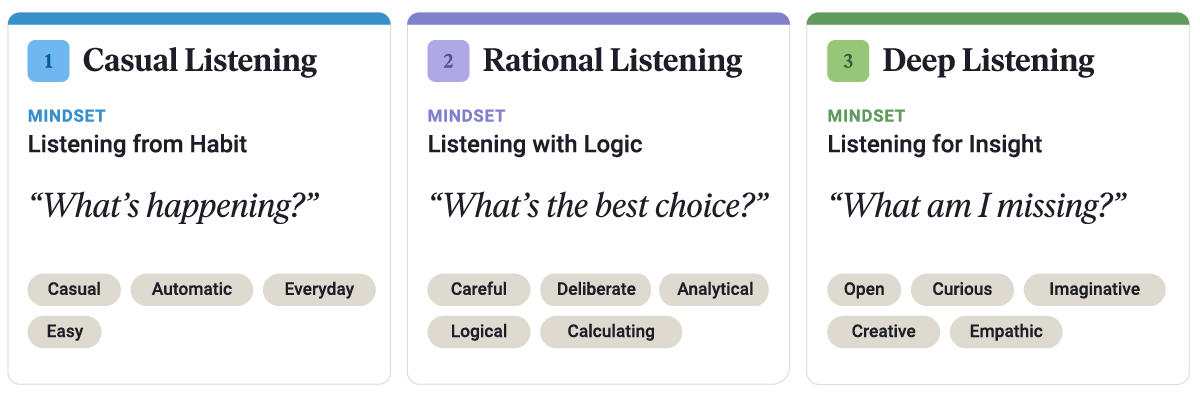
Three Ways to Listen

Casual Listening provides cues that trigger daily habits, enabling us to get through the routine aspects of each day smoothly and efficiently. Such cues may come from scheduling discussions, team meetings, text messages, or conversations with co-workers, and mean that we don’t have to reinvent every daily action. Phrases like “weekly meeting,” “report deadline,” or “snacks in the break room” are likely to evoke a familiar pattern of behaviors.

Rational Listening, on the other hand, requires people to slow down, observe, compare, analyze, and make deliberate choices. Those choices may or may not conform with established habits and are more adaptive to new situations or possible changes. As Daniel Kahneman says, this kind of activity also requires energy and attention and should be applied selectively. “Where should I sit in the meeting room?” is less important than “How will we reverse our decline in sales?”

The third listening mode, Deep Listening, has both cognitive and empathic components. More than either of the two other modes, it involves intentional openness, curiosity, and efforts to seek out and embrace new information and insights while adapting accordingly. People who have moved into new work roles or locations often find that prior patterns of success with colleagues or customers no longer lead to satisfactory results. Common examples include joining a multicultural team with colleagues from very different backgrounds, or an expatriate who must understand a customer’s needs in a market far from headquarters. Such drastic moves make it essential to inquire energetically and learn from others who know the new environment better.

In addition to cognitive insight, Deep Listening includes emotional receptivity and the ability to make connections, which Otto Scharmer and Peter Senge call “Empathic Listening.” This means being able to sense and respond to what colleagues are feeling, whether or not they voice their sentiments directly. The listener can perceive subtle messages or meanings signaled by facial expressions, gestures, or tone of voice.

Example: Getting Real Feedback

You recently delivered a virtual presentation to a group of colleagues. When you asked for questions or recommendations regarding your proposal, several people based elsewhere whom you don’t know well remained quiet and did not respond.

  • Casual Listening Response: Your presentation incorporated well-tested data and techniques you have previously been successful in using, so you assume that the silent participants just didn’t have much to contribute – they were more junior and probably lacked the skills or experience they would need to voice a meaningful opinion. You’ve asked them for questions already. 
  • Rational Listening Response: Send a follow-up message asking for more specific comments on your proposal and what they would recommend. Consider this input carefully before moving forward with your proposal.
  • Deep Listening Response: Schedule time for a more in-depth conversation with one or more of your counterparts. Send information and questions in advance so they can prepare. Try to learn about each person’s background, express interest in their point of view as well as the market they serve, and provide plenty of room and encouragement for them to share their ideas.

What Gets in the Way of Listening?

Casual listening is efficient and dominates our daily lives, but it is relatively impervious to new information. This becomes problematic in unfamiliar situations that require a non-routine response. Several possible obstacles stand in the way of moving beyond casual or habitual listening to the other two levels.

The first obstacle is psychological safety. Do your counterparts feel safe to tell you what they are actually thinking or feeling? They may fear being judged negatively, receiving a poor performance appraisal, reporting an embarrassing project failure, being excluded from the team, facing career derailment, or even losing their job. Employees or managers who seek to engage in Rational Listening or Deep Listening need to build an atmosphere of mutual trust in which colleagues believe they can:

  • Speak up and offer a different opinion that will be appreciated.
  • Point out an error, and it won’t be held against them.
  • Share an idea they are working on or unsure about, and they won’t be ridiculed.
  • Be who they really are without being rejected.

Another obstacle to non-habitual levels of listening is bias, conscious or unconscious. The CIAO model features four types of bias, each of which can get in the way of listening well or hearing new voices:

  • Confirmation Bias often accompanies habit-based listening, but is not conducive to listening at other levels. We tend to hear what we expect to hear, especially when it conforms to our personal agenda or to a narrative that incorporates our own beliefs about the world.
  • Insider Bias means that we listen selectively to the views of preferred people or groups, limiting the scope of what we hear. Whether insider status is based on rank, nationality, education, ethnicity, political affiliation, or other factors, the effect of insider/outsider dynamics on whom we pay attention to and how carefully we listen is similar.
  • Attribution Bias frequently causes us to misinterpret what we hear because we quickly assign credit or blame based on whether a person is seen as an insider or an outsider. Some counterparts can do no wrong; others are discounted and subjected to intense critical scrutiny from the start.
  • Overconfidence Bias impedes self-critical reflection because we are confident that we have heard and interpreted things accurately the first time, even in the face of evidence that our judgment may be incorrect.

Cultural differences also challenge our ability to listen. Culture shapes not only how we express ourselves but also how we interpret and evaluate others’ communications, and even what information we perceive or ignore. People striving to listen well in a different cultural setting must learn about local communication norms in order to hear messages accurately or perceive them at all. Culture is also embedded in language, and language differences may distort messages and create opportunities for misunderstanding.

Everyday messages and emotions are both “encoded” and “decoded” according to cultural standards. Raising one’s voice in anger, for instance, might be interpreted as a sign of passionate commitment in one cultural context and as unprofessional, out-of-control behavior in another. Nonverbal gestures and facial expressions are also clearly influenced by culture. Agreement or disagreement could be expressed in more indirect cultural settings through head movements, eye contact, posture, or the position of arms and hands. Intervals of silence between spoken words may also express comfort or discomfort, depending on accompanying gestures and cultural context. At times, such nonverbal signals may actually contradict a verbal message, communicating a different response which is quite clear within the context of that culture’s norms.

Moving Beyond Casual Listening

The ability to pivot fluidly between the three listening modes as circumstances change begins with active listening techniques. There are several interrelated techniques, applicable in most cultural settings, that enable listeners to move from Casual Listening to Rational Listening or Deep Listening.

Active Listening Techniques

Presence

  • Minimize distractions or interruptions
  • Focus on your counterpart with genuine interest
  • Listen to the words and observe non-verbal behaviors
  • Use culturally appropriate body language to foster mutual comfort (e.g., lean forward, nod, monitor your own facial expressions)
  • Suspend judgment until you have fully heard what the other person has to say

Reflection: Confirm what you hear through reflective listening

  • Restate, paraphrase, or summarize to reflect the other person’s views, ideas, or feelings
  • Ask for feedback regarding your restatement of what you heard
  • Avoid replying, disagreeing, or debating until you are sure you understand what is being communicated

Inquiry: Structured dialogue

  • Express interest with phrases such as:
    • “I’d like to hear what you think”
    • “I value your opinion”
    • “Could you please help me to understand the background for this?”
    • “Can you help me here?”
    • “What do you recommend?”, or
    • “Is there anything else you would like to add?”
  • Encourage responses through questions or requests to further draw out the speaker (“Please tell me more…”)
  • Allow time for others to reflect, translate thoughts between languages, and formulate responses
  • If the conversation is action-oriented, structure questions with a coaching model such as John Whitmore’s GROW model: Goal, Reality, Options, Way Forward

Listening with Cultural Agility

Cultural agility, too, fosters listening that goes beyond habitual behaviors shaped by environmental factors and repetition. It requires cultivating self-awareness, understanding others’ backgrounds, and using bridging skills to enable style-switching when needed. Five dimensions of culture – Independent/Interdependent, Hierarchy/Egalitarianism, Risk/Certainty, Direct/Indirect, and Task/Relationship – are particularly helpful in understanding one’s own default approach to listening as well as how to adapt to other work styles.

Taking the Direct/Indirect cultural dimension as an example, here are suggestions for how to “style-switch” for more effective listening. These adjustments build on the active listening techniques discussed above but are tailored to fit forms of communication shaped by culture.

Listening to indirect communicators Listening to direct communicators
  • Pay attention to nonverbal cues: Observe body language, tone of voice, and facial expressions. These can provide critical insights into the speaker’s true feelings or intentions, especially when their words are vague or noncommittal.
  • Ask open-ended questions: Encourage elaboration by asking questions that require more than a yes-or-no answer. This can help uncover underlying thoughts and feelings that may not be expressed directly.
  • Avoid interruptions: Allow the speaker to finish their thoughts without interruption. This demonstrates respect and gives you the opportunity to fully absorb their message.
  • Listen for patterns: Instead of focusing solely on specific statements, look for recurring themes or patterns in the conversation or related communications. This can help you grasp the broader context and implied messages.
  • Invite open dialogue: Foster an environment where your counterpart feels comfortable expressing their views.
  • Don’t over interpret others’ statements; some comments may be best taken at face value without ascribing underlying meanings.
  • Request input from the other person on ideas, proposals, or possible courses of action.
  • Encourage debate, which can be particularly valuable in cultures that value open discussion. Don’t be surprised or put off by open disagreement.
  • Clarify the main points being expressed by others if needed. Draw contrasts between different views, and highlight the most important areas of agreement or disagreement.
Sample countries with communication styles that are comparatively indirect on average: Indonesia, Japan, United Arab Emirates Sample countries with communication styles that are comparatively direct on average: Netherlands, Germany, Australia

Deep Listening

“Usually when you listen to some statement you hear it as a kind of echo of yourself. You’re actually listening to your own opinion… When you listen to someone, you should give up all your preconceived ideas and your subjective opinions; you should just listen, just observe what the person’s way is.”

Suzuki Shunryu, Zen Mind, Beginner’s Mind

In contrast to Casual Listening and the autopilot routines for which it provides cues, Deep Listening encourages the critical review of established beliefs and habits and the modification or discarding of what no longer serves us well. It also goes beyond the analytical deliberations of Rational Listening by focusing on the search for fresh insights.

Listening intentionally for what we have neglected or previously didn’t know is often the prelude to change. This kind of listening can be useful not only with everyday office colleagues, but even with friends or family members. Here are a few relatively straightforward ways to get started:

  • In your next conversation, refrain from responding immediately with your own opinion or thought, and instead try asking a question that will dig deeper.
  • Purposely seek out a story or an interpretation of an event from someone whose life experience is very different from your own.
  • Check for common forms of unconscious bias – for example, “flip it and test it” is a way to ask yourself whether you would react the same way if you were listening to a different person (say, someone within your in-group rather than an outsider).

Deep listening is also particularly vital when working across cultures because the differences between people tend to be greater and our expectations are more likely to be wrong. Outcomes, too, are less predictable in intercultural settings, and tried-and-true strategies may not work.

At Aperian, we had the opportunity to conduct a series of interviews with leaders across numerous organizations and industries whom their organizations identified as their most successful expatriates. Here are a few of their comments about learning to listen:

“We’ve tried to implement programs that worked at home, but they failed miserably here… We face a lot of challenges in a tough economy. I don’t know all the answers and we need to work things out together… You have to get to the point where people will tell you you’re wrong and explain why.”

“Assume that you know nothing every day. Be ready to open yourself to learn and make mistakes; be open to it.”

“The key thing is the ability to listen to other people, in the broadest sense: perspective, arguments, even hidden speech, culture. Don’t jump to conclusions before getting the rationale behind their behavior – investigate.”

These quotes reflect the growth mindset that is indispensable to Deep Listening. People who take on challenging new roles, especially those living outside their home country, commonly have what are called “crucible experiences.” Behavioral patterns and assumptions are reshaped through the crucible of hard-won lessons, both successes and failures. This transformation usually increases a person’s ability to respond flexibly to new circumstances and fosters related skills such as creativity.

The term “Invite the Unexpected” refers to a discipline associated with Deep Listening. Effective entry into new markets, for example, calls for keen insights into local customer requirements, competitive threats, regulatory restrictions, and impending social or political events. Leaders must position themselves to discover unfamiliar aspects of the local cultural and market environment that are crucial to solving business problems. Inviting the unexpected entails deliberately setting aside established forms of expertise and exploring unfamiliar ways of obtaining information and knowledge. The insights gained through Deep Listening often become the impetus for personal, professional, and organizational growth.

Deep Listening may produce insights with emotional content along with their cognitive and strategic implications. Managers and executives who want to build a fully engaged workforce must learn to listen especially for feelings of exclusion. Almost everyone has felt excluded at some point in their lives, but leaders of multicultural teams need to be especially attuned to others’ experiences, as these take various forms and vary in intensity. Here are some examples:
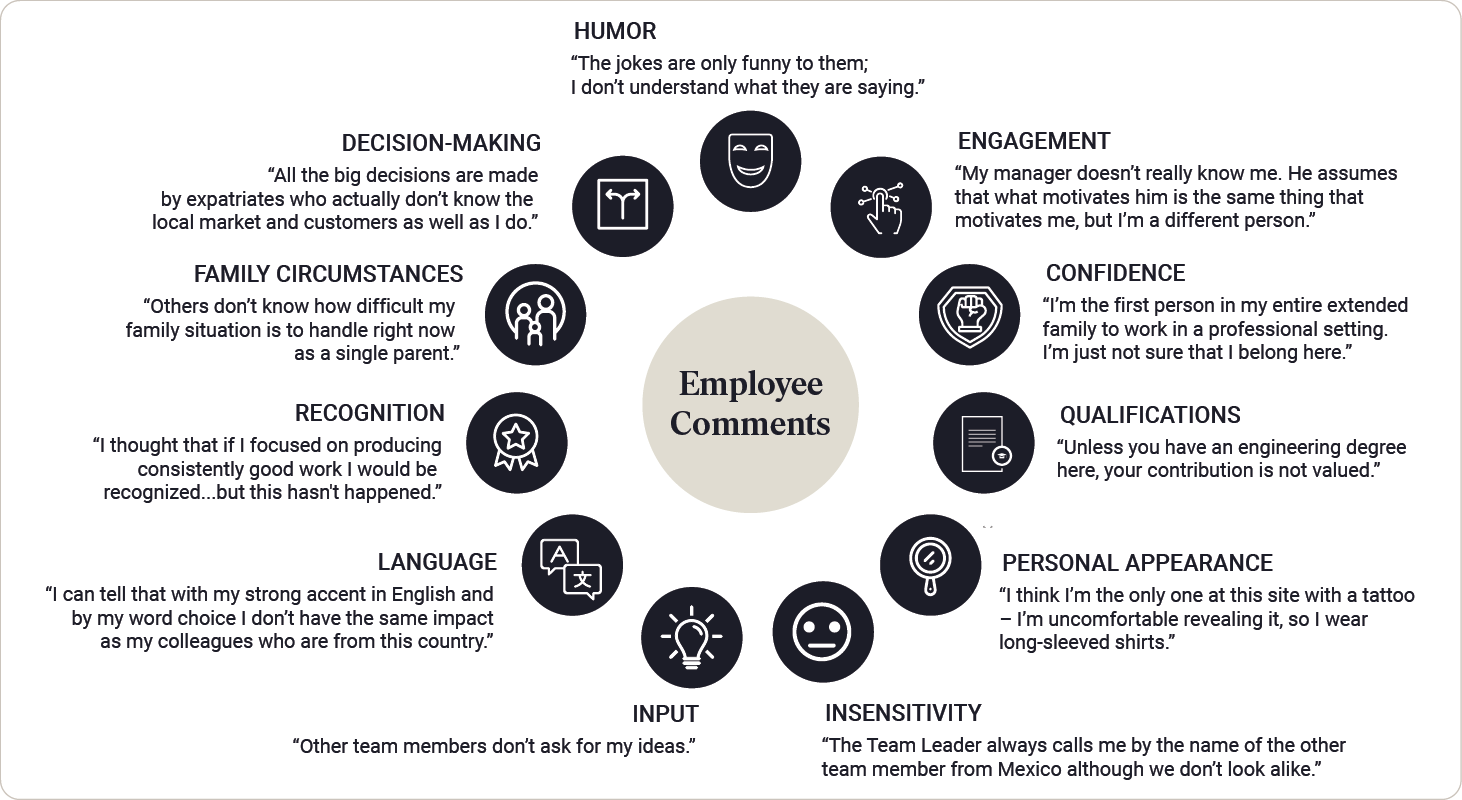
Possible Reasons for Feeling Excluded

Listening for insights into how others are feeling requires careful attention coupled with empathic understanding, affect, and action. Helpful actions are to:

  • Be an “empty” listener: Think of yourself as an open vessel that provides space for the concerns of others. Practice radical receptivity.
  • Expand your listening beyond the auditory channel to include observing gestures, facial expressions, and other nonverbal signals.
  • Be a generous listener: Avoid controlling the discussion by equating it to your own situation; not everything can be understood through your personal lens or through the prism of your own experience.
  • Assume positive intent until proven otherwise; someone may truly believe what they are saying even if you disagree.
  • Be patient with communication styles and accents different from your own.
  • Try to understand the “why behind the behavior.” What factors have caused the person to feel this way?
  • Expand your mindset to understand their thoughts and feelings; imagine yourself in their shoes. Reexamine your own assumptions or internal stories.
  • Notice how the other person’s feelings might be affecting you. Does their anxiety, fear, or loneliness resonate with or become mirrored by your own feelings?
  • Look for ways to translate your empathetic awareness into action. What assistance or support might you be able to provide?
  • Continue to reflect after a conversation, reviewing what occurred, how you responded, and how you might explore or expand a perspective or skillset. This could include rewatching part of a recorded meeting in which you participated to see what you might have missed.

Summary

Listening across cultures naturally incorporates all of the forms of listening in the human repertoire. However, working effectively with people from different backgrounds often requires less Casual Listening and instead reexamining and shifting away from habits that don’t translate well, while building a new behavioral repertoire. Rational Listening and Deep Listening can both serve this purpose, but Deep Listening is the best source of cognitive and emotional insights that inspire real personal and professional transformation.

How Culturally Agile is Your Team’s Listening?

Transforming a global team’s communication patterns doesn’t happen by accident, it requires shifting from comfortable defaults to intentional, deep connection.

At Aperian, we help teams cultivate the best practices that define high-performing global teams. Contact our experts today to explore how our learning solutions, including Listening Across Cultures, can help your multinational leaders unlock the power of Deep Listening.

Talk with an expert

Start Bridging Boundaries Today

Our quarterly newsletter provides the latest insights on cultural competence, team collaboration, and workplace learning.

Follow us

Platform

Live Training Platform Certifications Coaching GlobeSmart Profile Team Dynamics GlobeSmart Guides Aperian Copilot Inclusive Behaviors Inventory Aperian Live Learning Modules Individual Licensing Professors & Students Privacy & Security Accessibility

Impact Areas

Team Collaboration Cultural Competence Global Leadership Global Relocation Inclusion Life Sciences Energy Technology Financial & Business Services Food & Beverage Manufacturing

Why Aperian

About Us Success Stories Our Experts Our Partners AI & Aperian Careers Contact

Resources

Training Catalog Blog Webinars Guides Research Global Diversity Map Help Center
© 2026 Aperian Global, Inc.
Terms of Service Privacy Policy Cookie Policy
The "A" design and the Aperian name are protected marks of Aperian Global, Inc.

This site uses cookies to offer you a better browsing experience. Learn more about how we use cookies.

Aperian
Powered by  GDPR Cookie Compliance
Privacy Overview

This website uses cookies so that we can provide you with the best user experience possible. Cookie information is stored in your browser and performs functions such as recognising you when you return to our website and helping our team to understand which sections of the website you find most interesting and useful.

Strictly Necessary Cookies

Strictly Necessary Cookie should be enabled at all times so that we can save your preferences for cookie settings.

Show details Hide details
Name Provider Purpose Expiration
__cf_bm Cloudflare To read and filter requests from bots. (Functional) 30 minutes
_lscache_vary LiteSpeed To Provide the prevention of cached pages. (Functional) 2 days
ays_show_popup_only_once_1 AYS (popup box plugin) To only show the rebrand notice modal once. (Functional) Persistent
__hssc HubSpot To store anonymized statistics. (Functional) 30 minutes
3rd Party Cookies

This website uses Google Analytics to collect anonymous information such as the number of visitors to the site, and the most popular pages. This website uses Microsoft Clarity cookies to collect anonymized data on how visitors interact with the website—such as clicks, scrolls, and navigation patterns—to help improve user experience and site performance.

Keeping this cookie enabled helps us to improve our website.

Show details Hide details
Name Provider Purpose Expiration
_ga Google Analytics To store and count pageviews. (Statistics) 2 years
__hstc HubSpot To store time of visit. (Marketing) 13 months
_ga_3EKX6R7E6N Google Analytics To store and count pageviews. (Statistics) 1 year
_gcl_au Google Adsense To store and track conversions. (Marketing) Persistent
Hubspotutk HubSpot To store and track a visitor's identity. (Marketing) 13 months
Clarity Microsoft To store and track user behavior (Marketing) Persistent
__gads Google To advertise, serve, and render ads. Personalizing ads (depending on your ad settings) , limiting the number of times an ad is shown to a user, muting ads you have chosen to stop seeing, and measuring the effectiveness of ads. (Advertising) 13 months