
Cultural awareness assessment tools help global team members see where values and work styles differ across their team, so they can address friction before it turns into conflict. Some disagreement sparks better ideas, but the kind that breeds mistrust and personal criticism leads to gridlock. Drawing on decades of work with teams across national and cultural boundaries, this article summarizes the most common patterns of culturally based conflict and how a team-level cultural assessment enables leaders to anticipate and address them.
Disagreements among team members may be due to competing stakeholder interests, confusing strategies, or unethical conduct, and it is possible to analyze and deal with these on a case by case basis. However, the most frequent forms of everyday conflict we witness are based on differences in values and work styles. Here are examples of values that are embraced in varying degrees by national cultures and individuals around the world. They include life style, goal achievement, legal requirements, gift exchange, patriotism, and family and friends.
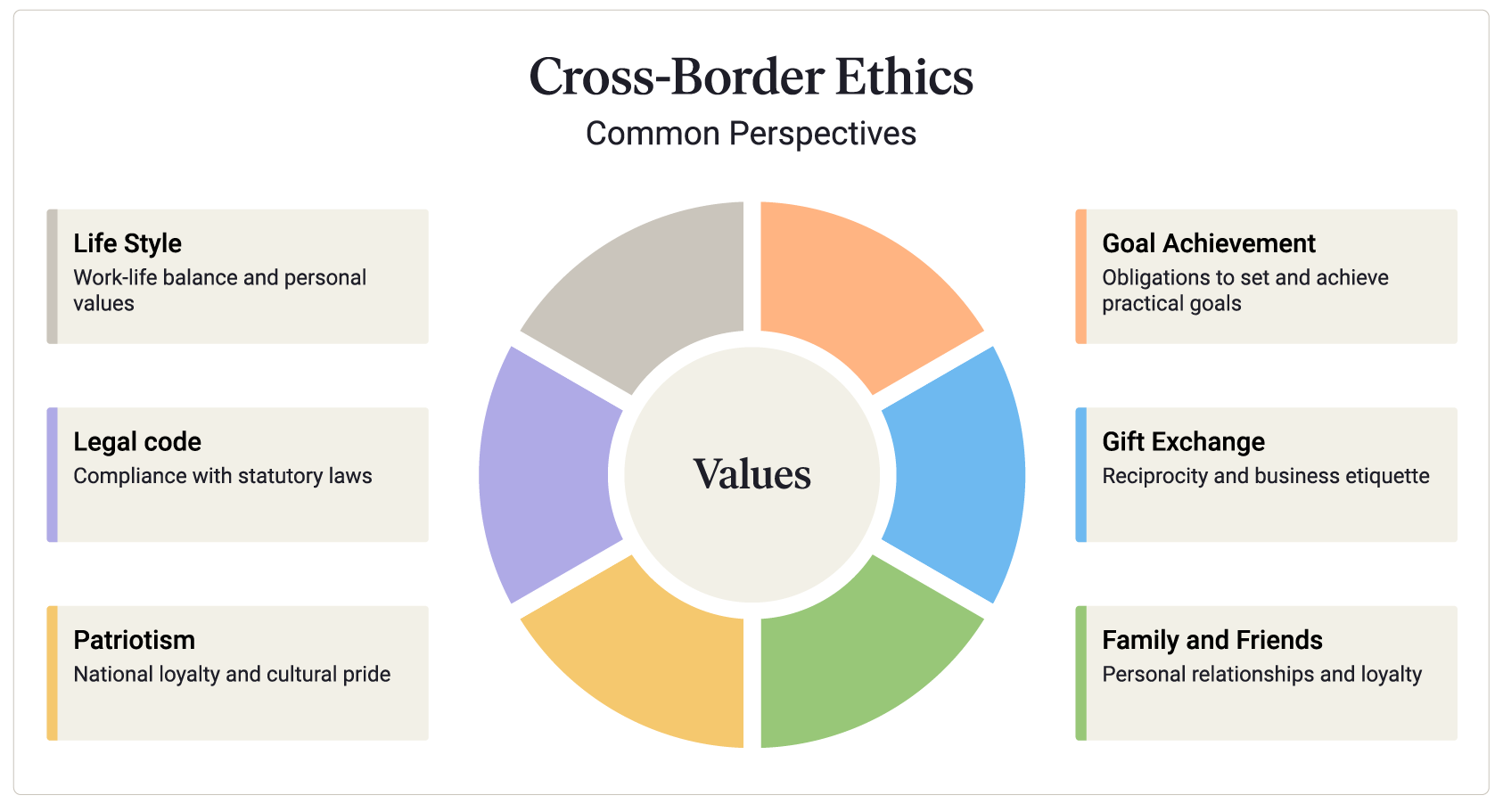
Two people with different primary values, each of whom considers themselves to be ethical, can easily experience persistent conflicts with each other that affect team performance. For example, those who have learned throughout their lives to prioritize workplace goals before their own personal life style may find themselves in disagreement with others who place higher value on their life style as well as family and friends. Relatively simple questions such as, “What hours should team members be available?” or “What is a reasonable vacation policy?” can quickly become sources of contention and negative judgments on the part of team members.
“What should be our organization’s policy on gift exchange?” is another topic that leads to friction and negative judgments when one set of team members is from an environment where seasonal gift-giving is acceptable and considered to be a form of good manners, while another from a more legalistic background views it as an unnecessary waste and a potential form of corruption. These kinds of differences can usually be addressed through stronger cross-cultural communication, a better understanding of each other’s cultural norms, and a willingness to be flexible on all sides within the limits of organizational policy and national laws.
Underlying such specific value clashes are general cultural differences that tend to shape each person’s approach to work and life, although there is substantial individual variation within every culture. The following are some of the most common differences that are captured in various cultural assessments, along with potential “Us vs. Them” judgments of people who are at either end of the spectrum. These dimensions draw on established intercultural research, including the work of Geert Hofstede, Fons Trompenaars and Charles Hampden-Turner, and Florence Kluckhohn and Fred Strodtbeck, as well as Aperian’s own research, publications, and twenty-five years of GlobeSmart data.
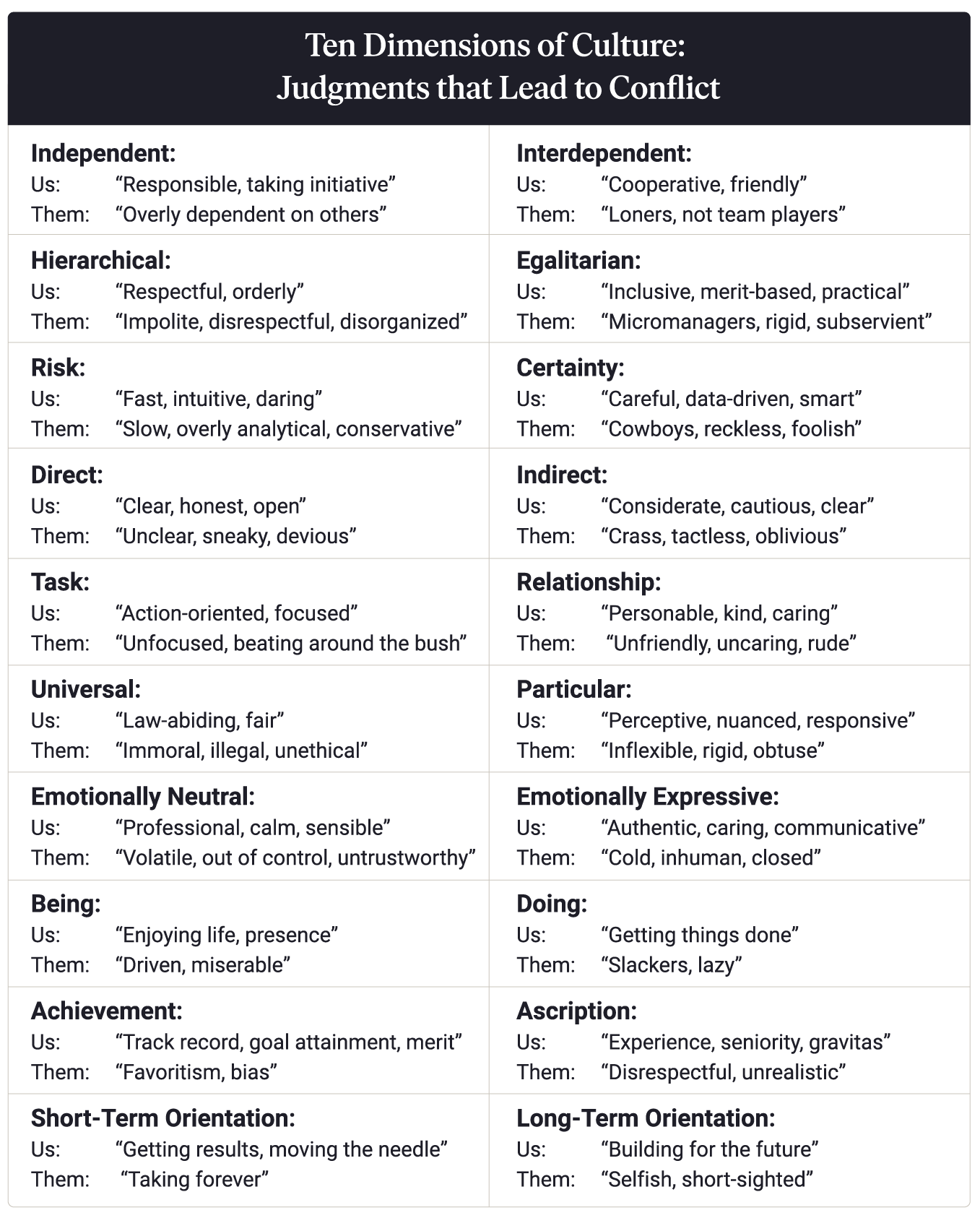
So how can cultural assessments be useful in anticipating potential friction points and addressing them before they become full-blown conflicts? According to our recent analysis of GlobeSmart Profile data from 3,879 teams, focusing on the first five dimensions on this list, more than two out of three global teams (68%) have a critical perspective gap on every one of these dimensions. In other words, on each dimension the team has no one who naturally operates from one of the two ends of the spectrum, such as no one who favors hierarchical authority, indirect diplomacy, or relationship-first decision-making. Relatively uniform team member perspectives may not matter in a monocultural environment, but in a multicultural setting this means that teams are likely to default to a single mindset and have significant perception gaps in dealing with colleagues or customers. For example, more than 70% of global teams have no one with a strong preference for Indirect Communication. This means that team members may neglect, misinterpret, or misjudge indirect messages from critical stakeholders unless they take deliberate remedial steps. The majority of the world’s population, including people in major markets such as India, China, Indonesia, Brazil, or Japan, tends to favor more indirect forms of communication.
Here is an example of a GlobeSmart Profile for a specific team, using the five cultural dimensions we have selected for their practical value and the robustness of statistical data from respondents.
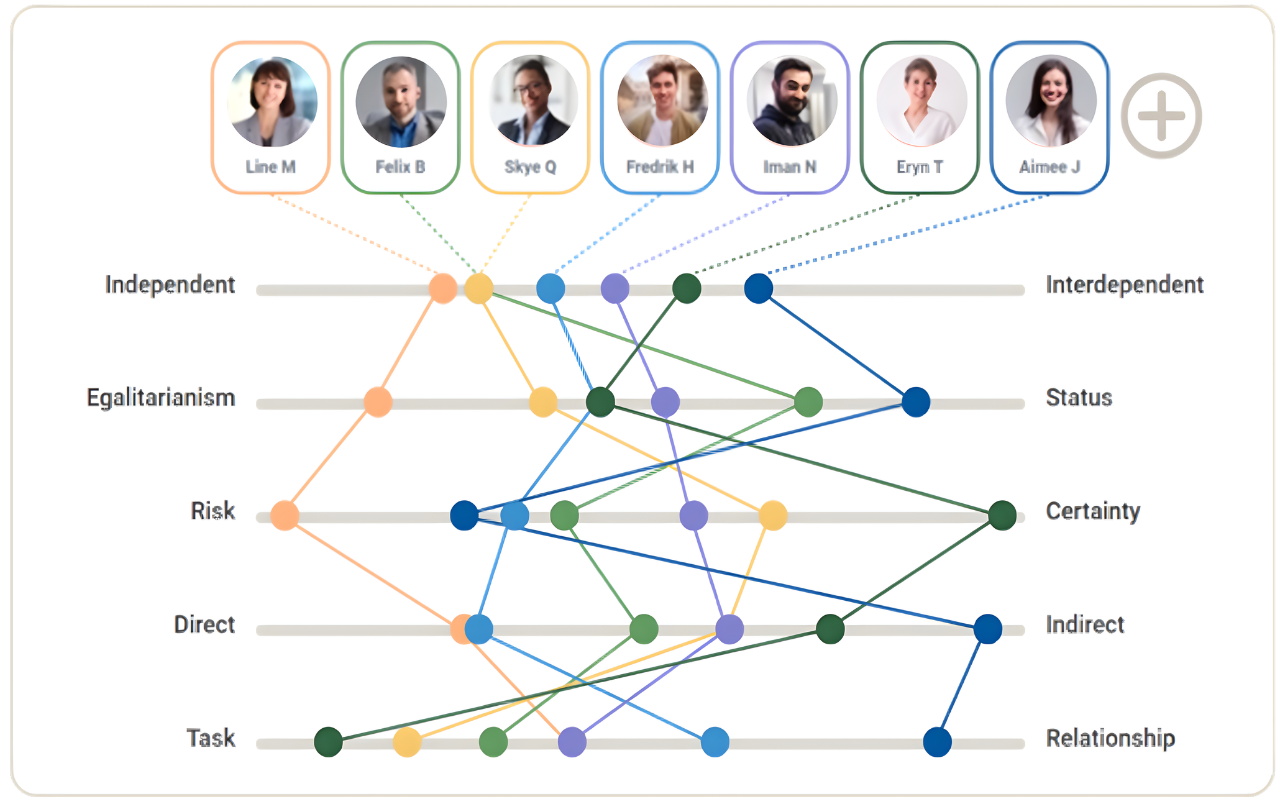
In this sample team, Line scores much further toward Risk than her team, most of whom lean toward Certainty. Scores vary on Task/Relationship, but Aimee sits well toward Relationship compared with everyone else.
Line, the Danish team leader in this case, will first of all need to recognize that her own profile differs significantly from those of other team members. Because she is more risk-oriented than the rest of the team, for example, she could potentially find herself in conflict with certainty-oriented team members who want to move more slowly and cautiously than she would prefer. Such friction can easily lead to negative judgments in both directions. Keeping in mind this difference, Line could proactively acknowledge the different perspectives of team members, affirm how they can all add value, and then invite the whole team to consider ways to integrate risk-taking with careful data analysis. They might even be able to coin a shared term for this such as “reasonable risk-taking” or “data-based risks.”
Another way to use the team profile could be to identify and leverage the skills of team members who appear to be outliers. In the team profile example above, there is some variation among team members along the Task/Relationship dimension. However, the team member “Aimee,” who is depicted on the far right side of this dimension, is considerably more relationship-oriented than the rest of the team. Rather than have Aimee feel isolated and excluded while Line and other team participants dive directly into tasks, the team could ask Aimee to suggest ways, perhaps starting with a few minutes at the beginning of each meeting, that they could get to know each other better. Such relationship-building can forestall negative judgments and contribute to trust and psychological safety, intangible assets that nonetheless have an impact on the team members’ ability to work together effectively. Aimee could also be a valuable source of advice when it comes to dealing with others outside of the team, including customers, who may be more relationship-oriented. Handling culturally-based differences in this way helps to head off overt or covert forms of conflict and more fully utilizes the capabilities of all team members.
Strong global team collaboration starts with making cultural differences visible. Here’s how leaders can put a team assessment to work:
Imagine an organization where each team, instead of spiraling into unnecessary misunderstandings and conflicts, has fully engaged and contributing team members. Well-designed cultural awareness assessments help teams spot collaboration risks early, communicate better, and perform at a higher level.
A cultural awareness assessment tool measures a person’s preferences on cultural dimensions such as direct versus indirect communication or risk versus certainty. Team versions combine individual results to show where members align and where friction is likely.
They reveal differences in values and work styles before those differences turn into negative judgments. When team members understand why a colleague might seem “slow” or “reckless” to them, they can address the underlying difference instead of the person.
According to GlobeSmart data from 3,879 global teams, the most common gap occurs with the Status and Hierarchy dimension: 86% of teams have no one at the hierarchical end of the spectrum. Indirect Communication comes next, with more than 70% of teams lacking a strong indirect perspective. These teams may default to flat decision-making and direct feedback, and misread colleagues and customers who expect otherwise.
Personality assessments measure individual traits. Cultural assessments measure work style preferences shaped by cultural background, such as attitudes toward hierarchy, risk and relationships. This makes them especially useful for multicultural team management.
Recommended times are when a team forms, when a new leader joins, when the team expands into new markets, or when recurring tension appears. Many organizations also use team assessments to support employee engagement goals by making sure every perspective is understood and valued.