
In global organizations, cultural misunderstandings are often brushed off as small communication issues or personality clashes, or worse yet, mistaken for performance issues. But for leaders managing distributed teams, these moments of friction can quietly affect collaboration, slow execution, and weaken innovation across the business.
A missed deadline. A meeting where nobody challenges a flawed idea. A regional office that feels disconnected from headquarters. These issues often get written off as “people problems” when they’re actually signs of cultural agility gaps that can have a significant impact on team performance.
As organizations expand across borders, hybrid work environments, and cross-functional teams, the ability to navigate different communication styles, decision-making norms, and workplace expectations becomes essential. Teams that lack cultural awareness often struggle with trust, alignment, and accountability. Teams that build cultural agility create stronger collaboration, faster execution, and more inclusive ways of working.
One of the most common sources of workplace friction comes from differing attitudes toward time, deadlines, and planning.
In monochronic cultures, time is treated as structured and linear. Deadlines are fixed commitments, meetings follow strict agendas, and punctuality is closely tied to professionalism and accountability.
In polychronic cultures, time is often viewed more flexibly. Relationship-building, responsiveness to changing circumstances, and adapting to evolving priorities may take precedence over rigid schedules.
Neither approach is right or wrong. Problems start when teams assume everyone interprets deadlines and priorities the same way.
For example, a project manager in Germany may view a deadline as non-negotiable, while a colleague in Brazil may see the timeline as adaptable depending on changing business realities or stakeholder needs. Without shared expectations, this difference can quickly be interpreted as disorganization, inflexibility, or lack of accountability.
Over time, these misunderstandings create real operational costs, including:
The challenge isn’t simply managing schedules more aggressively. It’s helping teams understand how cultural norms influence workplace behavior, so they can create shared ways of working.
Communication style is another major source of cultural misunderstandings in global teams.
In low-context cultures, communication tends to be explicit, direct, and highly verbal. Team members are expected to clearly state opinions, provide straightforward feedback, and document decisions precisely.
In high-context cultures, communication often relies more heavily on implied meaning, shared understanding, and nonverbal cues. Direct disagreement may be softened or avoided entirely to preserve harmony or to show respect for hierarchy.
When these styles collide, misunderstandings are common.
A manager from a low-context culture, like the Netherlands, may interpret indirect feedback as evasive or unclear. Meanwhile, a colleague from a high-context culture, like China, may perceive direct communication as unnecessarily blunt or disrespectful.
These gaps become even more challenging in virtual environments where teams rely heavily on email, Slack, and video calls. Without the benefit of in-person context or relationship history, subtle cues can easily be missed.
Consider a global project meeting where team members respond to a proposed strategy with polite silence. A leader accustomed to directing discussion may assume agreement and move forward. In reality, several participants may have concerns they’re reluctant to express openly in a group setting.
The result is often delayed execution, hidden misalignment, or passive resistance that surfaces later in the project lifecycle.
Many global team challenges become easier once teams can see how individual work styles come together to influence collaboration, communication, and decision-making.
GlobeSmart Profile Team Dynamics provides a team-level view of work-style differences, helping teams understand where alignment exists, where friction may emerge, and how to work together more effectively.
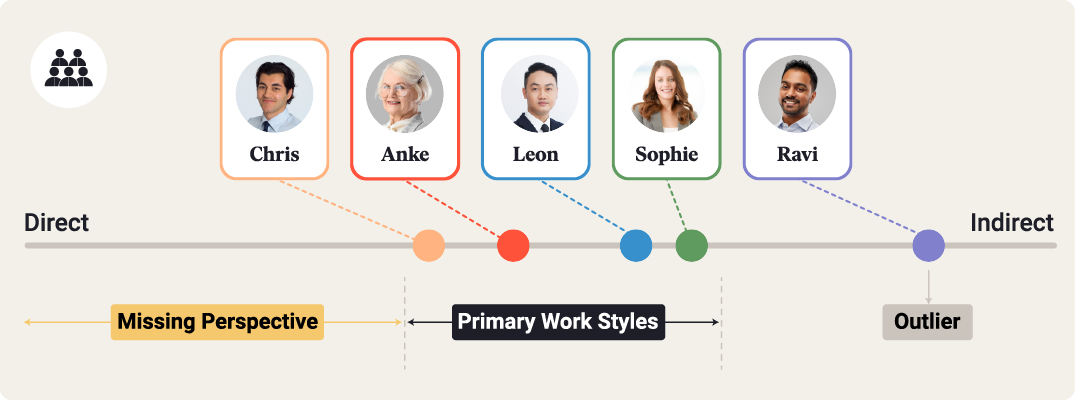
Rather than focusing solely on individual preferences, Team Dynamics shows how those differences interact across the group and offers practical strategies to strengthen collaboration, trust, and performance. This positioning reflects Aperian’s team-level experience that helps organizations improve collaboration, alignment, and performance.
When teams develop a shared understanding of how they work together, they’re better equipped to:
Cultural misunderstandings become even more damaging when leadership unintentionally reinforces ethnocentrism, or the assumption that one’s own cultural norms are the default way of working.
In multinational organizations, this often shows up as “HQ bias.”
For example, a U.S.-based leader may interpret a Japanese colleague’s silence during a meeting as disengagement or lack of preparation. In reality, the silence may reflect respect for hierarchy, thoughtful consideration, or reluctance to publicly contradict a senior stakeholder.
Similarly, headquarters teams may unintentionally prioritize communication styles, meeting structures, or decision-making processes that align with their own cultural assumptions while overlooking how those norms affect regional teams.
Over time, these dynamics can lead to:
The issue usually isn’t intentional exclusion. More often, it’s a lack of awareness around how workplace norms vary across cultures.
Virtual work has amplified many of the cultural misunderstandings that already existed in global organizations.
In face-to-face interactions, teams can rely on body language, informal conversations, and relationship-building to interpret intent. In digital communication, many of those contextual signals disappear.
A brief Slack message may be interpreted as efficient by one employee and cold or dismissive by another. A delayed email response may signal deep focus in one culture and disrespect in another. Camera usage during meetings, expectations around availability, and approaches to feedback can all vary significantly across regions.
Even small misunderstandings add up over time.
Without cultural awareness, teams often default to negative assumptions:
In reality, many of these behaviors are rooted in differing workplace norms, not poor intent.
That’s why international business etiquette is no longer just a concern for expatriates or global executives. In hybrid and distributed organizations, cultural agility has become a core collaboration skill for employees at every level.
Global teams don’t need to eliminate every misunderstanding. What matters is building the skills to recognize differences early, talk through them productively, and keep collaboration moving forward.
Cultural agility isn’t about memorizing etiquette rules or avoiding mistakes entirely. It’s about understanding how culture shapes communication, decision-making, feedback, and trust at work.
When teams develop that awareness, they collaborate more effectively across regions and functions. They reduce friction before it slows projects down. And they create environments where people feel more comfortable contributing fully.
In today’s hybrid and global workplaces, those skills aren’t optional. They’re essential for performance.
If your teams are struggling with communication gaps, collaboration friction, or misalignment across regions, cultural agility training can help uncover what’s really getting in the way.
Aperian helps global organizations strengthen collaboration through practical learning experiences, team development tools, and culture-focused assessments that help employees better understand themselves and each other.
Whether you’re supporting hybrid teams, leading cross-functional initiatives, or managing global collaboration at scale, Aperian gives teams practical strategies for working more effectively across differences.
Explore Aperian’s cultural agility solutions to help your teams improve communication, strengthen inclusion, and perform at a higher level together.