
Clients seeking to use Aperian’s GlobeSmart Profile along with one of the familiar personality tools—e.g., MBTI, DiSC, Insights Discovery, or the Hogan suite—ask whether such assessments overlap or are complementary. This issue is relevant to executives, team managers, and learning leaders seeking to invest in resources that enable them to be most effective in achieving their goals.
Questions we often hear include:
The ways in which personality and culture affect workplace interactions are related to the well-known debate over the influence of “Nature versus Nurture.” Humans are shaped by both their genetic heritage (Nature) and the environment in which they are raised (Nurture).
Anyone who has been around small children recognizes, usually with a smile, that they already display distinctive character or personality traits from a young age. These traits may evolve or vary over time as people age and mature, but many remain remarkably stable and consistent throughout a person’s lifetime. Environmental influences also shape how basic personality traits are expressed in language, gestures, emotions, core values and beliefs, and patterns of social interaction. Personality and culture constantly intermingle, with some behaviors shaped more by a person’s personality and others more by situational factors influenced by cultural norms.
Although some personality models are originally derived from theories involving varying patterns of responses to different kinds of environments, in practice their focus tends to be on fixed traits with easy-to-remember labels: colors, names, acronyms, and even bird types. Workplace behaviors that are more culturally based are relatively dynamic and changeable compared with static personality characteristics. A person who moves from one cultural environment to another, while retaining their predominant personality traits, may take on new behaviors or values and integrate these with their prior cultural identity.
For example, many leaders who have lived abroad find that their own cultural profile has changed to reflect elements of their host culture as well as their national culture of origin—a person who was formerly a very direct communicator becomes better able to read indirect messages, or a person from a group-oriented environment has become more individualistic. “Third culture kids” are those who have lived in multiple countries or grown up in households with parents from different cultural backgrounds, and are often able to bridge between cultures through their ability to “style-switch.”
Most personality assessments are based on some variation of what are commonly labeled as the “Big Five” traits, established through decades of psychological research. All five of these traits can be measured on a spectrum from greater to lesser displays of a particular characteristic:
Culture is typically described in terms of dimensions, with a range of possible behaviors between the ends of each spectrum:
National cultural differences persist both in spite of and because of rapidly changing technology, including artificial intelligence (AI). People in completely different geographies now have access to similar information that is subject to “cultural skew” and “algorithmic monoculture,” favoring Western models. At the same time, there are movements toward indigenization of AI sources along with mutually exclusive social media echo chambers that reinforce in-group perspectives and actually deepen cultural gaps within and between countries. It can be tempting to assume that others are becoming “more like me” due to superficial appearances (and conveniently that I don’t have to change or adapt), when the reality may be that they are deliberately trying to distance themselves from you and your perceived values.
Here is a general set of contrasts between personality and cultural assessments:
Personality and Cultural Assessments: Comparisons
| Type | Personality Assessments (e.g., DISC, MBTI, Hogan) | Cultural Work Style Inventory (e.g., GlobeSmart Profile) |
| Purpose | Individual self-awareness and adaptation to other personality styles. | Cultural self-awareness and adaptation to people from other cultural backgrounds. |
| Stability | More Static: Traits remain relatively consistent over a lifetime. | More Dynamic: Profile can shift based on cultural setting and learning to adapt or “style-switch.” |
| Business Value | Mutual understanding and adjustment, interpersonal relationships, and teamwork. | Cultural agility, multicultural team performance, cross-border collaboration, and new market entry. |
| The Lens | Focused more on the Foreground (The Individual). | Focused more on the Background (The Context). |
There are personality traits such as Extraversion, Conscientiousness, and Agreeableness that correlate with expatriate success in different cultural environments, although assignment success factors also depend on location, job type, and rank. At the same time, an extensive body of research has demonstrated that cultural variables affect both which personality traits tend to dominate in a particular environment, and how those factors are expressed.
For example, Chinese appear to score lower on measures of extraversion than U.S. population samples. Malaysians score higher than Westerners on Agreeableness, but lower on Extraversion and Openness. Even within the same country, ethnic groups may differ: European-American men generally score higher than Asian-American men on extraversion and openness. The relative interdependence, or group orientation, of Asian cultures likely influences these personality differences.
The same personality characteristics are also manifested differently because of the cultural variables listed above: “expression of personality traits differs profoundly across different cultures as a function of the different socio-cultural conditioning and experiential learning that takes place within different cultural settings.” Further research indicates that culture shapes not only how we express ourselves, but also how we interpret and evaluate communications from others, and even what information we perceive or ignore.
Encoding & Decoding: The way that humans express emotions, for instance, varies according to established cultural norms for encoding and decoding feelings. Anger or joy might be demonstrated, or encoded, more explicitly in countries that value independence and directness. Forms of expression that are commonly deemed acceptable in one environment may also be interpreted, or decoded quite differently in another—a display of anger in a negotiation could be seen either as a sign of caring and commitment or as “unprofessional.” In more hierarchical environments, the expression of anger toward a subordinate could be seen as acceptable, while the reverse behavior from a subordinate to a manager could be taken as grounds for dismissal.
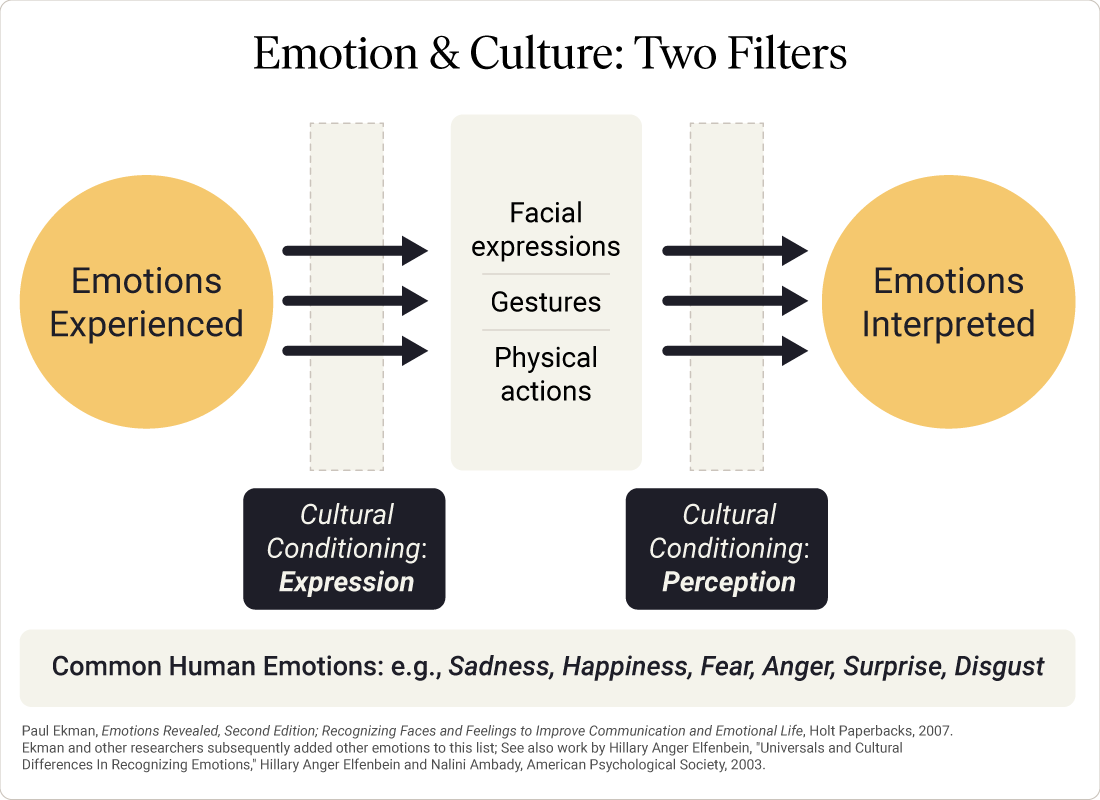
Nonverbal Communication: Nonverbal gestures and facial expressions are also clearly influenced by culture. For example, the degree to which a person presenting to an audience uses broader or more limited hand gestures tends to be shaped by implicit cultural rules: a presenter who gesticulates with large hand movements may be seen as entertaining in one culture but as unreliable or unstable in another. Agreement or disagreement could be expressed in more indirect cultural settings through head movements, eye contact, posture, or the position of arms or hands. At times, such nonverbal signals may actually contradict a verbal message, communicating a different response which is quite clear within the context of that culture’s norms.
A study of Japanese and U.S. volunteers found that the brain region that produces dopamine, the “feel-good hormone,” in response to reward stimulation functions in ways aligned with cultural values. Researchers showed the two groups of volunteers drawings of people standing in a submissive pose with their head down and shoulders hunched, and drawings of people standing in a dominant pose with arms crossed and face forward. The brain’s positive reward circuit in the Japanese group was activated by the submissive stance, which probably was interpreted as a modest or respectful posture in Japan and thus aligned with core Japanese hierarchical and interdependent values. Meanwhile, the U.S. group showed brain activity in this same region for the dominant stance, which may have been interpreted as confident or appropriately assertive—behaviors that are rewarded in U.S. society. One of the implications of this research, affirmed by the experience of many people working across these two countries, is that it is easy to make serious cross-cultural mistakes in evaluating subordinates or selecting talent.
Perception: Behavioral studies show distinct attentional orientations along cultural lines that affect what observers actually perceive, in addition to how they express themselves. In other research involving both Western and East Asian participants, Westerners, whose cultures place a high value on independence and individuality, tended to focus their attention on individual objects. In contrast, East Asian participants, whose cultures emphasize interdependent relationships and awareness of context, showed attentional focus on context and relations among objects and events within their field of observation.
Due to this difference between attention to foreground objects or to background context, the personality trait of conscientiousness, which involves attention to detail, could take quite different forms. This shows up in cross-cultural interactions, for example, in the degree to which “bottom-line” indicators or background context are prioritized in presentations or problem-solving discussions. “People of different cultures literally see the world, and the people in it, differently.”
Personality and cultural assessments tend to have common general aims: building greater self-awareness and flexibility to help people interact more effectively with their workplace counterparts. They take different paths to achieve this, and both kinds of assessments are important and complementary.
Considering the types of challenges employees face helps determine how to allocate tight budgets to best address current organizational pain points.
Scenario A: The Manager Who Lacks Empathy
Scenario B: Solving Friction in Global Teams
Scenario C: High-Stakes Global Leadership
Creativity that sparks innovation in the form of new products and processes often comes from a balance of personality factors and cultural intelligence. The personality characteristic of “Openness” features curiosity and creativity; “Conscientiousness” is also required to move from creative proposals to actual implementation, and “Extraversion” to socialize and spread ideas. Exposure to multiple cultures also fosters creativity through seeking out information from diverse sources, generating fresh ideas, and combining them in novel ways. Leaders seeking to promote innovation and to leverage the full capabilities of their workforce must ultimately integrate knowledge of personality types with cultural intelligence and agility.
Is your organization facing global team friction or preparing leaders for cross-border roles? Investing in the wrong assessment tool can leave critical organizational pain points unaddressed. Let us help you design a holistic strategy that integrates personality insights with world-class cultural agility. Explore the GlobeSmart Profile to get started.