

Managing global teams has never been more complex. Organizations are expected to move quickly across markets, maintain consistent standards, and foster collaboration across distributed teams, all while respecting the cultural realities of each region.
The challenge is that many global initiatives fail not because the strategy is flawed, but because leaders confuse alignment with uniformity.
Uniformity assumes every team should work the same way. Alignment focuses on shared goals, clear expectations, and adaptable collaboration practices. This difference matters when it comes to behavior change
When organizations push rigid processes without accounting for regional work-style differences, communication norms, or decision-making styles, teams often respond with resistance, delayed adoption, or disengagement. High-performing global organizations understand that operational consistency does not require cultural sameness. Instead, they create systems that allow regional teams to contribute while preserving local autonomy and trust.
Keep reading to explore practical management approaches for global teams, including how to navigate cross-cultural management challenges, build trust across regions, and create alignment without forcing every team into the same mold.
In global organizations, alignment means teams understand the mission, priorities, and desired outcomes. Uniformity, by contrast, attempts to standardize how every team works, communicates, and collaborates regardless of local context.
That distinction is critical in cross-cultural management.
A global headquarters may define success through speed, direct communication, and aggressive timelines. But regional teams may prioritize consensus-building, relationship management, or hierarchical approval processes before moving forward. Neither approach is inherently wrong; they simply reflect different cultural norms around collaboration and decision-making.
Problems arise when leaders interpret those differences as resistance instead of context.
For example, a multinational company rolling out a global transformation initiative may require every region to adopt identical reporting structures, meeting cadences, and escalation processes. While this creates consistency on paper, it can unintentionally undermine trust in regions where informal relationship-building and informal alignment conversations are central to getting work done.
The result is often what many organizations experience as “selective skepticism.” Teams comply publicly but disengage privately. Adoption slows. Local leaders stop advocating for the initiative because it feels disconnected from operational reality.
Effective management approaches for global teams recognize that shared outcomes matter more than identical behaviors.
Organizations that succeed globally typically establish:
This balance creates consistency without erasing local strengths.
For leaders trying to strengthen organizational alignment, resources like Aperian’s guide to defining company culture can help clarify which values should remain global and which practices should remain flexible.
One of the most common friction points in managing global teams is the clash between high-context and low-context communication styles.
In low-context cultures (like the United States, Germany, or the Netherlands), communication tends to be explicit, direct, and highly structured. Leaders often expect concise updates, standardized reporting, and immediate clarity.
In high-context cultures (common across parts of Asia, the Middle East, and Latin America), communication relies more heavily on relationships, nuance, and shared understanding. Information may be conveyed indirectly, especially when preserving harmony or hierarchy is important.
The tension becomes especially visible when a low-context headquarters imposes rigid communication standards on high-context regional teams.
For example:
Over time, misunderstandings compound into operational friction.
This does not mean organizations should abandon structure. It means leaders need communication systems that account for cultural variation.
High-performing global leaders often adapt by:
Understanding these differences is foundational to effective cross-cultural management. Aperian’s article on navigating nonverbal communication in different cultures explores how subtle communication dynamics can impact collaboration across regions.
Trust is often discussed as though it develops the same way everywhere. In reality, trust-building varies significantly across cultures.
In some regions, trust is established through competence and task execution. Teams build credibility by delivering results consistently, meeting deadlines, and demonstrating expertise.
In others, trust develops relationally. People may prioritize personal connection, shared experiences, and interpersonal reliability before fully engaging in collaboration.
Global leaders who overlook these differences often unintentionally create barriers.
For example, a leader from a task-oriented culture may push directly into project execution with a newly formed international team. Meanwhile, team members from relationship-oriented cultures may perceive the approach as transactional or impersonal, reducing openness and engagement.
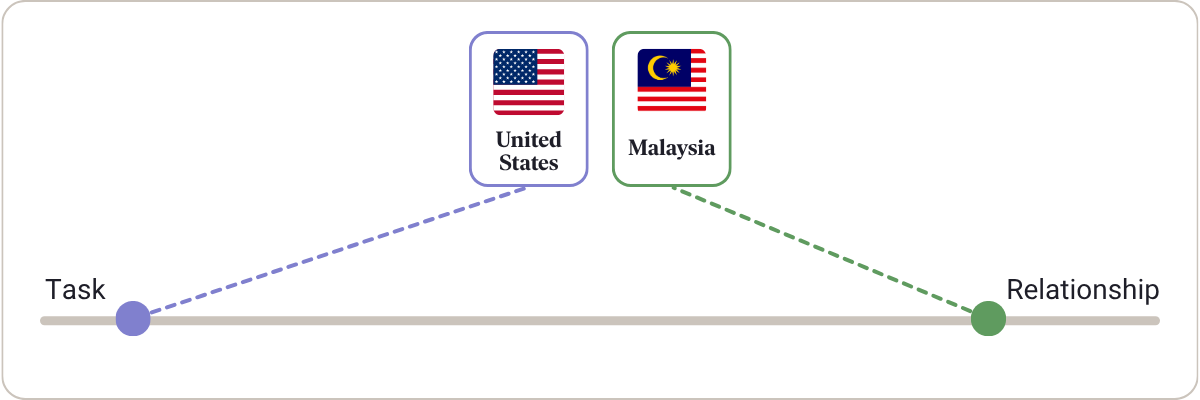
GlobeSmart® Profile, Task – Relationship dimension of culture
The same dynamic applies to psychological safety.
In flatter organizational cultures, psychological safety may look like openly challenging ideas, debating decisions, or speaking candidly in meetings. In more hierarchical environments, employees may hesitate to publicly question authority, even when they have concerns or valuable input.
This creates a major challenge for leaders managing global teams: the same leadership behavior can produce entirely different outcomes across regions.
Building alignment requires leaders to adapt their feedback loops and collaboration practices rather than assuming a single universal model will work everywhere.
Managing global teams effectively requires more than awareness training or one-time workshops. Leaders need practical ways to identify gaps in collaboration, anticipate friction points, and create systems that support alignment across regions without forcing teams into rigid behaviors.
That’s where structured insight becomes valuable.
Aperian’s GlobeSmart Profile helps organizations understand how different work styles influence communication, trust, decision-making, and collaboration across teams. Rather than treating cultural differences as obstacles, leaders can use the platform as a team alignment map, identifying where friction may emerge and proactively building strategies to bridge those gaps.
The broader Aperian platform is designed specifically to support culturally agile, high-performing global teams through tools that strengthen collaboration, reduce conflict, and improve team effectiveness across regions.
Organizations can also reinforce these capabilities through targeted learning experiences focused on cultural agility, collaboration, and global teamwork. Aperian’s training catalog includes programs such as Improving Team Collaboration with the GlobeSmart Profile and Communicating Effectively Across Cultures, both designed to help teams work more effectively across regions.
When organizations combine cultural insight with flexible leadership practices, they create stronger alignment without sacrificing regional strengths.
Global alignment doesn’t require uniformity. The strongest international teams succeed by combining shared goals with culturally adaptive leadership practices that build trust, collaboration, and accountability across regions.
To learn how your organization can strengthen collaboration across global teams, explore the Aperian platform or discover how the GlobeSmart Profile helps teams bridge work-style differences before they impact performance.
The key is establishing clarity around outcomes while allowing flexibility in execution. Global leaders should define shared goals, accountability measures, and decision-making expectations while giving regional teams autonomy in how they achieve those objectives.
Micromanagement typically increases when leaders mistake unfamiliar work styles for poor performance. Strong cross-cultural management practices help leaders distinguish between genuine issues and cultural differences in communication or collaboration.
One of the biggest barriers is assuming that successful practices from one region will automatically transfer globally without adaptation.
Communication styles, hierarchy expectations, trust-building behaviors, and decision-making norms vary widely. Organizations that ignore these differences often experience friction, disengagement, and stalled initiatives despite strong strategic intentions.
Psychological safety is shaped by cultural expectations around authority, communication, and group harmony.
In some cultures, employees demonstrate engagement by openly challenging ideas. In others, public disagreement may be viewed as disrespectful or disruptive. Effective leaders adapt how they solicit feedback and create inclusion based on regional norms rather than relying on a single model.
Data-driven tools help leaders identify collaboration gaps before they escalate into larger organizational problems.
Solutions like the GlobeSmart Profile provide visibility into how team members approach communication, feedback, decision-making, and trust. These insights help managers build more effective collaboration strategies while reducing misunderstandings across regions.
For organizations managing global teams at scale, these tools create a more consistent foundation for alignment without forcing teams into rigid, one-size-fits-all behaviors.