
Mergers and acquisitions (M&A) often start with a compelling business case. The financial projections make sense and the integration roadmap appears solid.
Then suddenly, one team thinks decisions are taking far too long, while another team feels they’re being rushed. A leader in one region expects people to challenge ideas openly, while his or her counterpart in another region sees that same behavior as disrespectful. Employees who were highly effective in their former organizations can find themselves frustrated by colleagues who simply work differently.
That’s where culture can become one of the biggest (and most overlooked) risks to post-merger success.
When two organizations combine, employees bring established ways of communicating, making decisions, building relationships, and navigating authority. When those expectations collide, cultural friction can slow execution, weaken trust, and delay the very benefits the merger was designed to create.
For change leaders, transformation managers, and operational executives overseeing large-scale integration efforts, understanding why cultural clashes happen is essential. The earlier teams can recognize and talk about these differences, the less likely they are to harden into an “us versus them” divide.
Culture clashes rarely start because people recognize a cultural difference. They start because they don’t.
When our own way of communicating, leading, or making decisions feels “normal,” a different approach can easily look inefficient, indecisive, aggressive, disengaged, or just plain wrong.
Most M&A integration plans focus heavily on systems, processes, legal requirements, governance structures, and organizational design. Those elements matter of course, but they represent only part of the integration challenge.
The human side of integration often receives less attention.
In the early months following a merger, employees are trying to answer fundamental questions:
How are decisions made here?
Who has authority?
How quickly should work move?
How much collaboration is necessary before taking action?
When these questions remain unclear, teams begin filling in the gaps with assumptions.
One legacy team is used to debating ideas openly in meetings; the other expects disagreement to happen privately. One expects leaders to make the call; the other expects everyone to weigh in first. One sees a fast decision as efficient; the other sees it as reckless.
These misunderstandings frequently emerge among mid-level managers responsible for translating executive strategy into operational reality and managing newly combined teams. When friction develops at this level, decision cycles lengthen, trust erodes, and execution slows.
This is why an M&A culture clash can undermine even the most carefully planned transformation. Without a deliberate strategy for post-merger cultural integration, organizations risk creating parallel cultures that continue operating as separate entities long after the merger is complete.
Two teams can be equally capable, committed, and successful yet have very different expectations about how work gets done.
Consider teams in Poland and India. Looking at the two cultures through the GlobeSmart Profile can reveal meaningful differences in areas like hierarchy, communication, and decision-making.
Those differences can show up in surprisingly ordinary moments: Who speaks first in a meeting? Is it appropriate to challenge the leader? Does “yes” mean agreement, acknowledgment, or simply “I hear you”? How much context should accompany feedback?
None of these approaches is inherently better. The risk comes when people interpret unfamiliar behavior through their own cultural lens.
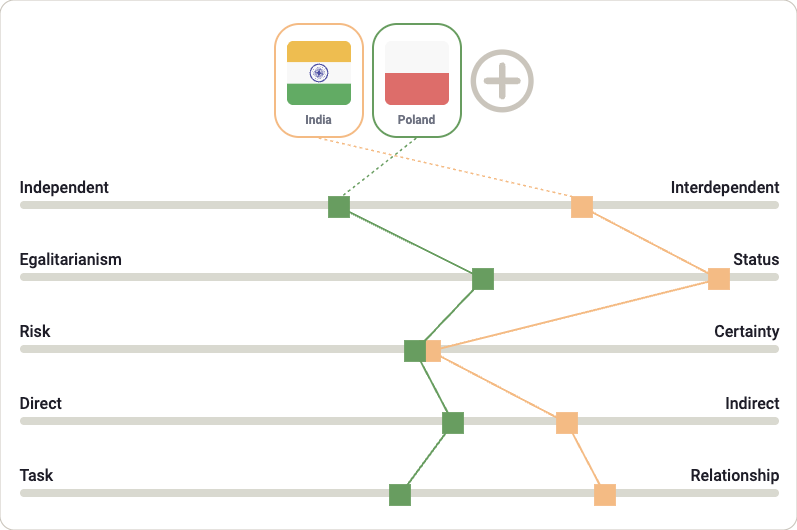
None of these approaches is inherently better than the others, but problems arise when teams interpret unfamiliar behaviors through their own cultural lens.
Without a shared understanding, project teams can experience:
For organizations navigating transformation, these challenges are particularly costly. Global teams often operate across time zones, business functions, and reporting structures. Add cultural friction to the mix, and even routine collaboration can become difficult.
This is why successful integration requires more than introducing common processes. Teams need a shared framework to understand how different work styles shape communication, collaboration, and decision-making.
Cultural agility helps employees recognize differences without assigning negative intent. Instead of viewing unfamiliar behaviors as obstacles, teams learn to adapt their approach and work more effectively across boundaries.
One of the most common patterns after a merger is the emergence of an “us versus them” mindset.
Employees continue identifying with their legacy organization. Teams compare processes, challenge decisions, and defend familiar ways of working. Over time, these divisions can solidify into cultural silos that become increasingly difficult to dismantle.
The critical window for preventing this outcome is often much shorter than leaders expect.
Employees begin forming impressions and assumptions almost immediately after integration begins. The longer misunderstandings persist, the more likely they are to become accepted narratives within the organization.
Creating alignment early helps organizations establish a common language before these divisions become entrenched.
The last thing employees navigating a merger need is another complicated process.
They may already be working through new reporting structures, systems, responsibilities, and relationships. Cultural integration needs to make that transition easier—not add another layer of complexity.
The GlobeSmart® Profile gives newly combined teams a practical way to understand how they work differently. In about 10 minutes, individuals gain insight into their preferences across five dimensions of work style, helping teams surface differences in communication, decision-making, hierarchy, and collaboration.
More importantly, it gives people a way to talk about those differences.
Instead of “They’re impossible to work with,” the conversation can become, “We have different expectations about how decisions should get made.”
Instead of debating which legacy team has the “right” approach, managers can explore what each team brings—and where they may need to adapt.
That shared language can help depersonalize friction, build trust, and give newly combined teams a stronger foundation for working together.
The GlobeSmart Profile helps individuals and teams better understand work styles related to communication, collaboration, and decision-making, providing practical insights that support stronger working relationships across organizational and cultural boundaries.
Book a demo today to further explore the GlobeSmart Profile and get started.
The most significant cultural clashes typically occur when employees operate with different assumptions about communication, decision-making, leadership, accountability, and collaboration. Problems intensify when these differences go unaddressed, and teams begin attributing negative intent to behaviors they don’t understand.
Cultural friction can slow decision-making, increase misunderstandings, reduce trust, and delay project milestones. In global teams, these challenges are often magnified by geographic distance, time-zone differences, and varying regional business norms. Over time, unresolved friction can undermine the operational efficiencies that mergers are designed to create.
Organizations often benefit from solutions that provide immediate, practical insights without adding significant complexity. The GlobeSmart Profile is a work-style assessment that helps individuals and teams understand how they collaborate, communicate, and make decisions, enabling leaders to establish a shared framework for working together more effectively.
When organizations treat cultural integration as a business priority from day one, they are better positioned to turn merger strategy into operational success. The sooner teams develop a common understanding of how they work together, the sooner they can focus their energy on achieving the goals that brought the organizations together in the first place.